

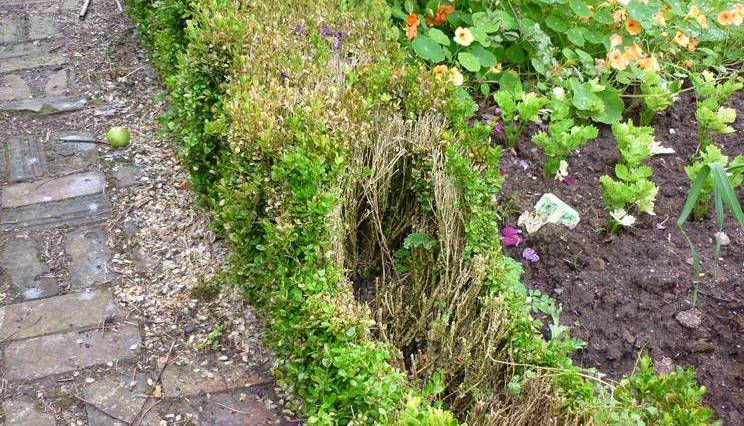
Gaps and Holes in Hedges – although they look stable, trimmed hedges are far from protected from problems and imperfections.
Various reasons lead to the fact that the fence will lose its attractiveness:
-
- incorrect calculations
- wrong choice of species
- bad winter
- damage to plants by pests
- odiseases
- improper care
Let’s look at the most common problems with the structure of hedges and how to solve them. This will help to restore the gaps and holes in hedges or effectively overcome them with the help of decorative techniques. And do not forget to call your nearest professional gardener anytime you need help with it.
Masking the “bare” bottom with a hedge of cypress and thuja
The half-naked hedge of cypress and thuja is the result of too much pruning. Pruning to the lignified parts of the branches results in exposure to these plants. The thing is that the buds for renewal in plants are laid only on young green shoots, in contrast to the same deciduous shrubs and yews. As a result of heavy pruning, the luxurious and previously green hedge may not be renewed at all.
The only option is to try to stimulate the vigorous growth of plants by providing them with regular watering, fertilizing, and spraying in the coming seasons. If that doesn’t help, then you have several options for additional. Masking solutions to this problem through methods to complicate the structure or decoration:
- Plant another row of plants in front of the bare hedge. A bottom row of other plants and a strict line of a figured border of boxwood and topiaries planted in one row can be considered a masking “front”. You can even create a kind of maze to cover the exposed trunks of an old fence.
- In the role of camouflage order, you can also use beautiful flowering shrubs that will hide the unattractive part of the hedge.
- Arrange ethereal wooden gratings or other supports and plant vines.
Hedge repair and renovation
If your living green wall needs renovation due to improper planting, violating the recommended planting distances, or disease or death of individual shrubs, then the strategies to solve this problem are the following:
- The narrow gap can be easily hidden with the branches of neighboring plants in the hedge. To do this, you just need to tilt the shoots, tie them to sticks and pegs, place supports, directing individual branches so that neighboring plants close and eventually close the hole.
- Boldly cut the gap and make a kind of curly niche or window in the hedge. The window can be of any shape and size, and be placed at any height, giving your garden austerity or, conversely, originality and unusualness.
- Combine a figured or trimmed strict hole with an insert in the space. Trimmed boxwood shrub or flowering shrub that will look like a living sculpture in a hedge.
- Carefully align the edges of the gap and place a garden sculpture, lantern, decorative gate, etc.
- Replace part of the green wall with a section of the fence with other materials. Shape the walls of clinker bricks, build a stone column, and place a cast fence, door, or wooden fence, which will create a game of textures and illusions.
- Install support for a colored vine in front of the gap, to create an additional passage or niche, niche, seating, “carved” in the green wall.